Technology Surrounds Us so Why Not Take Advantage
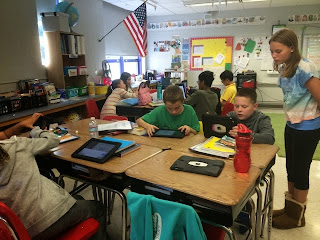
This week all the classes I teach set up their Notability accounts. What is Notability you say? Notability is an app that students can use to keep track of notes, pictures, etc. It syncs with GoogleDrive so that this personal iPad app is now accessible through GoogleDrive. What does this mean to you? Now you can see the work children are doing in school right at your fingertips.
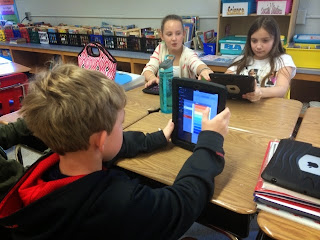
In Math, children worked on a math worksheet through the app, shared in GoogleDrive, and assigned and turned in through Google Classroom. The students are learning how to keep their work in an organized manner while enjoying the process of employing technology. Parents can see this work from home by having their child log into their own Google Drive accounts because all the Notability work is synced with GoogleDrive. Take a look to see just what these savvy mathematicians can do!
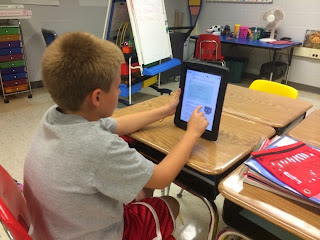
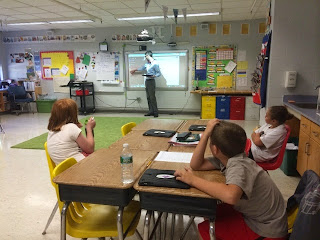
In ELA, children set up their folders and quickly were assigned to photograph various completed graphic organizers. For the children, this means the increased opportunity for independence. If you are asking how, let me explain. These correctly completed exemplars are available for students to look at to review just how to use them. This will simplify the process of selecting the right organizer for the job and exactly what is required for filling it out. For parents, you can see just what your children can do and what is expected of them every day.
Here you can see Mr. Schersten, our technology specialist demonstrating the app set up. Color coded subject folders were set up and linked to GoogleDrive. Then children photographed the different classroom created graphic organizers and titled them correctly for later use. Independence and empowerment are set up!
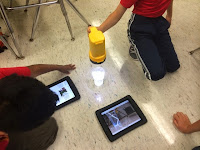
In science, this meant we were set up to be the scientists we should all be to test and learn about our world and how it works. Children photographed their already completed prism experiments in a note called Prisms. As the week progressed, students used the app to organize, question, plan, experiment and observe outcomes of experiments. They drew pictures for plans, utilized text books to locate various ideas and scientific terms, typed a list of necessary materials and made predictions about what they thought the outcome might be. Now, they can look back and 'reflect' on the learning and the process. Look at that, they are learning like scientists already!
In this experiment, children were testing their ideas about refraction. They noticed that the pencil, straw, ruler or spoon look broken as the light travels from the air to the water. Next week we will try to come up with why that might be. Be sure to ask.


Refraction in action!


 As we continue with our discoveries of light, students practice being scientists. Questions are encouraged, explorations are welcome and observations are discussed...usually until there are more questions. This might not be the way our parents learned science but it certainly is how we're doing it.


 This week all the classes I teach set up their Notability accounts. What is Notability you say? Notability is an app that students can use to keep track of notes, pictures, etc. It syncs with GoogleDrive so that this personal iPad app is now accessible through GoogleDrive. What does this mean to you? Now you can see the work children are doing in school right at your fingertips.
 In Math, children worked on a math worksheet through the app, shared in GoogleDrive, and assigned and turned in through Google Classroom. The students are learning how to keep their work in an organized manner while enjoying the process of employing technology. Parents can see this work from home by having their child log into their own Google Drive accounts because all the Notability work is synced with GoogleDrive. Take a look to see just what these savvy mathematicians can do!

 In ELA, children set up their folders and quickly were assigned to photograph various completed graphic organizers. For the children, this means the increased opportunity for independence. If you are asking how, let me explain. These correctly completed exemplars are available for students to look at to review just how to use them. This will simplify the process of selecting the right organizer for the job and exactly what is required for filling it out. For parents, you can see just what your children can do and what is expected of them every day.

 In this experiment, children were testing their ideas about refraction. They noticed that the pencil, straw, ruler or spoon look broken as the light travels from the air to the water. Next week we will try to come up with why that might be. Be sure to ask.


 What's Going on with that Garden Back There?

 Many vegetables are already picked and hopefully eaten, but how do we continue the process? Did you know that some vegetables from school gardens go to local food pantries?

 To keep the process going, master gardener Peter Coppola came for a visit with dried bean seeds for us to check out. How did they become dry? What can we do with them? Why do the different seeds look different?
 Next comes a variety of tomatoes like Purple Cherokee and Moon Glow. We noticed the differences between the different tomatoes. How do we get these tomatoes again next year? Hmm!
 Let's cut into the tomatoes and see what we can do. The insides of tomatoes are juicy, wet and filled with seeds. If we scoop out the seeds and put them into cups we can begin the process of drying the seeds to keep these kinds of tomatoes in our garden for next year.
 After digging out the seeds, we put them into water to sort the pulp from the seeds. Next steps: daily stirring, drying out and seeing the differences in our dried tomato seeds. Be sure to come back for more!


 Our second experiment was to use prisms to create rainbows. As we were trying to make our rainbows, the children noted that the rainbow never traveled straight through the prism and out. Rather the rainbow came out to the side.

 A great first day of experimentation was had by all. The children took turns, listened to each other, answered their own questions and more.


