Showing posts with label Classification. Show all posts

Friday, October 13, 2017

Invertebrate Safari

The Land of the Lost Invertebrates

What Makes an Invertebrate an Invertebrate


As we finish our explorations of the elusive invertebrates, students became the scientists in the Land of the Lost Invertebrates. They were met with these curious creatures, rain forest sounds, binoculars and fact cards (another student's animal riddle card.)


Once they explored all of these unique critters they went back to their newly identified animal and presented their findings to their fellow investigators. The results were impressive. All of the animals were correctly identified. 

The students were asked to observe all of the animal inhabitants prior to deciding which animal they were searching for. Clues on the card broke down animal structures, features, habitat, eating habits and more.


Finally, the scientists will work together to determine the traits of these strange lost creatures. I'm sure they will be able to identify the structures, characteristics, environments, eating habits and more of these less familiar inhabitants from our own scientific explorations. In the end, the students will break down mollusks, marine invertebrates, crustaceans, worms, insects and arthropods both myriapods and arachnids. Our study of the invertebrates will be wrapping up shortly!


Saturday, April 16, 2016

The Invertebrates come to an End


And, class two has just completed their study of the invertebrates. I am sad to say goodbye to animal classification as this was the most fun we've ever had doing it. Allowing the children to research and utilize their findings to be the creator of their own animal allowed them the freedom to be creative, the opportunity to learn and the lightheartedness of a self made game. Being the 'scientists' discovering these new species with riddle clues allowed them a rich fun learning experience. 


After announcing their discoveries to the class, students were called upon to decipher the animal secrets by unpacking the specific features of the more familiar invertebrates. I was very impressed with their findings. Students were able to share the features of their own researches animal group, the riddle animal and the findings of the other scientists and artists. They were even quick to use the text book and internet to find more classification ideas. Way to go 220!


It amazes me how fifth graders come to us without the clear cut skill set of finding and using information independently to learn from and leave with many of the skills required to do research. This time, I didn't have to give them any extra directions to use resources to add to our animal facts. 


Sunday, April 3, 2016

Invertebrate Showdown


The Land of the Lost Invertebrates

Completion of What Makes an Invertebrate and Invertebrate

As we finish our explorations of the elusive invertebrates, students became the scientists in the Land of the Lost Invertebrates. They were met with these curious creatures, rain forest sounds, binoculars and fact cards (another student's animal riddle card.)
The students were asked to observe all of the animal inhabitants prior to deciding which animal they were searching for. Clues on the card broke down animal structures, features, habitat, eating habits and more.
Once they explored all of these unique critters they went back to their newly identified animal and presented their findings to their fellow investigators. The results were impressive. All of the animals were correctly identified. 


Finally, all of the scientists worked together to determine the traits of these strange new creatures. We were able to identify the structures, characteristics, environments, eating habits and more of these less familiar inhabitants from our own scientific explorations. We correctly broke down mollusks, marine invertebrates, crustaceans, worms, insects and arthropods both myriapods and arachnids. Our study of the invertebrates is complete!

Friday, March 25, 2016

What Makes an Invertebrate an Invertebrate?

            Create Your Own Invertebrate


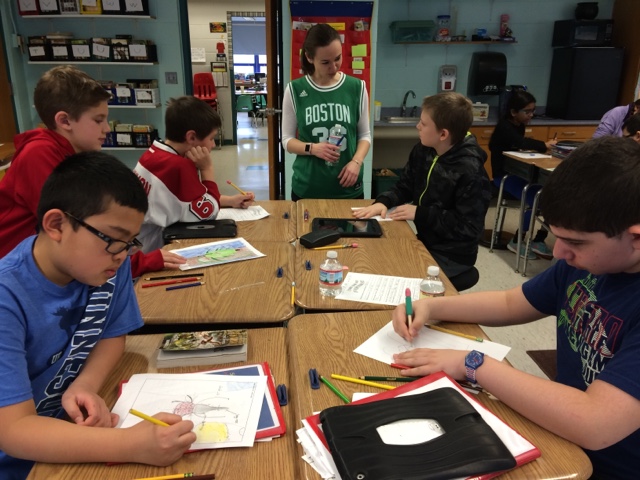
Over the past weeks, we've studied classification. We've noticed how kingdoms narrow into animal groups and then specific animals. The children have come to determine it is the structures of the animals that classify them. This has been relatively easy up until this point. The INVERTEBRATES!


Now the children are asked to works backwards to create an invertebrate that could exist. They need to create this animal in a real habitat with real structures. Poisonous animals should be brightly colored. Ocean animals should have dark colored tops and light colored bottoms. Local forest animals should be of darker colors like their surroundings.

Children were reminded of science from the years past. We are looking at habitats, predator/prey relationships, adaptations, ecosystems and more.


So far, I have seen an elephant beetle with a long pointy nose that stabs to protect itself and colorful venomous invertebrates along with animals with suckers, slime and more. Once the animal drawings are complete, the riddles will be written. These riddles then become the lesson for the different types of invertebrates. Who knew learning could be so engaging!


This 'elephant beetle' will make students start off questioning if it is an insect and then more specifically which one with only a riddle to guide the students on their way. Using the clues, the students will be the scientists to classify these new species!


Although this looks like a fish, don't be fooled; its special structures make it a specific invertebrate. Can you figure out which one? Don't give it away. At this point, students are becoming more independent because they don't want to give away their animal secrets. 


This worksheet is just one example of the problem solving that had to be used to work backwards to create a new animal. As the children came to check in, they began to understand the relationship between structures and classification. 


Another fun lesson was that of perspective. If an insect is small, how large must a tree or a leaf be? On the other side of this, students will quickly recognize that this animal must be poisonous because of its bright colors. I wonder how this one will catch its dinner. I hope it's an herbivore. 


The children have almost completed the information page and drawings. Some are working on the riddle cards...and they are all excited to become THE SCIENTISTS!

Saturday, September 20, 2014

Francis Wyman Garden, Seeds and Master Gardener Peter Coppola

What's Going on with that Garden Back There?

Room 103 students took a tour of the garden behind the school last week. We saw watermelons, pumpkins, tomatoes, beans and more.  This led to our main purpose, seed drying and classification...along with a short reflection of light energy and color.


Many vegetables are already picked and hopefully eaten, but how do we continue the process?  Did you know that some vegetables from school gardens go to local food pantries? 


Welcome Peter Coppola!


To keep the process going, master gardener Peter Coppola came for a visit with dried bean seeds for us to check out.  How did they become dry?  What can we do with them?  Why do the different seeds look different?  

Next comes a variety of tomatoes like Purple Cherokee and Moon Glow.  We noticed the differences between the different tomatoes.  How do we get these tomatoes  again next year?  Hmm!

Let's cut into the tomatoes and see what we can do. The insides of tomatoes are juicy, wet and filled with seeds.  If we scoop out the seeds and put them into cups we can begin the process of drying the seeds to keep these kinds of tomatoes in our garden for next year.


After digging out the seeds, we put them into water to sort the pulp from the seeds.  Next steps: daily stirring, drying out and seeing the differences in our dried tomato seeds.  Be sure to come back for more!