

Saturday, April 30, 2016
After PARCC Down Time
PARCC definitely changes our routine in a way that warrants some flexibility. So we all enjoyed some indoor recess time as a well deserved break.


Saturday, April 16, 2016
The Invertebrates come to an End


And, class two has just completed their study of the invertebrates. I am sad to say goodbye to animal classification as this was the most fun we've ever had doing it. Allowing the children to research and utilize their findings to be the creator of their own animal allowed them the freedom to be creative, the opportunity to learn and the lightheartedness of a self made game. Being the 'scientists' discovering these new species with riddle clues allowed them a rich fun learning experience.


After announcing their discoveries to the class, students were called upon to decipher the animal secrets by unpacking the specific features of the more familiar invertebrates. I was very impressed with their findings. Students were able to share the features of their own researches animal group, the riddle animal and the findings of the other scientists and artists. They were even quick to use the text book and internet to find more classification ideas. Way to go 220!


It amazes me how fifth graders come to us without the clear cut skill set of finding and using information independently to learn from and leave with many of the skills required to do research. This time, I didn't have to give them any extra directions to use resources to add to our animal facts.


More on Our Innovative Classroom

It is truly amazing to me to see my ideal student work space coming together. A place where students are met with a problem solving group space to identify problems and determine solutions. Just last week, final items came down from the wall to allow for paint and our unique white board wall to use as a community work space. This week our first table was put together.
 I find it interesting how this experience is allowing me to grow as a teacher. So much of this work is foreign to me. I learned that measuring wood to cut has to account for some wood loss as it is sawed away. I learned about the different sizes of screws, and the jobs of drivers and drills. In the end, I discovered that I needed to see some of these things unfold to understand them, or hold them in my hand to acknowledge how they work. It is a great reminder of how individual students need to learn.
 So many others have stepped up to help out, or just come by to support our innovative environment. If it weren't for Francis Wyman's 'Tech Guru,' Ben Schersten, there wouldn't even be a plan for this great table. If it weren't for Diana Marcus, I am not sure what standing desks would be in my room.
  Watching the children take on one new piece of furniture at a time has allowed us all to figure out best uses and best practices. I am impressed with the number of children already choosing standing over sitting.
I am even more excited to complete our transformation from a traditional classroom to what I hope to be a place where children love to come and work together, where they welcome a challenge and where they see each other as an asset in their learning.
Sunday, April 3, 2016
Invertebrate Showdown

The Land of the Lost Invertebrates
Completion of What Makes an Invertebrate and Invertebrate
As we finish our explorations of the elusive invertebrates, students became the scientists in the Land of the Lost Invertebrates. They were met with these curious creatures, rain forest sounds, binoculars and fact cards (another student's animal riddle card.)The students were asked to observe all of the animal inhabitants prior to deciding which animal they were searching for. Clues on the card broke down animal structures, features, habitat, eating habits and more.


Once they explored all of these unique critters they went back to their newly identified animal and presented their findings to their fellow investigators. The results were impressive. All of the animals were correctly identified.


Finally, all of the scientists worked together to determine the traits of these strange new creatures. We were able to identify the structures, characteristics, environments, eating habits and more of these less familiar inhabitants from our own scientific explorations. We correctly broke down mollusks, marine invertebrates, crustaceans, worms, insects and arthropods both myriapods and arachnids. Our study of the invertebrates is complete!
Saturday, April 2, 2016
Reading and Acting Out "Number the Stars"
The boys and girls have been reading my all time favorite fifth grade core book, Number the Stars. This historical fiction chapter book by Lois Lowry is about the escape of a Jewish family from Copenhagen during World War II. The story centers on ten-year-old Annemarie Johansen, who lives with her family in Copenhagen in 1943. She questions her bravery throughout the book due to her fear, but when the time comes to help her best friend and their family she comes to find out bravery is not quite what she thought it was.
Students were asked to study example reader's theaters and make one of their own on a chapter from the book. Each group did an amazing job with just a week's time to listen to, create and practice their own chapter from the book. Here is just a taste.
Friday, March 25, 2016
Stools, Standing Desks and Bean Bag Chairs Are Here
 They are Here!
After waiting for what seemed like forever, our grant items started coming in today. First off, 'the first' truck was the shipment of stools. As we came back from the lunchroom, the children, who are just as eager as me, volunteered to carry them up individually. As they were coming up to the room, the next truck came with the standing desks, bean bag chairs and tables.


The children were all 'happy' to read during ELA just to know that end result would be using the stools. We quickly removed the chairs and implemented the stools. The children got their testing faze out of the way and were ready to get right back to work. We continued reading Number the Stars on the iPads but now, children were sitting up and not slouching; they appeared more engaged! Test 1 holds true!


 Next, the standing desks with rocker bars. Can the children make it through an entire class standing. Truth is, yes, but not preferred. We quickly moved the stools to the desks and had some happy children all around. The next step was to introduce the bean bags. They are for a real purpose. They can use them for reading and research as a reward for making the right choices. The boys and girls got right to their reading in hopes that they would be among the first to read on the bean bags. Even more, the reading was constant and consistent.
Step one is clearly working out and the experimental stages are quickly making way to new routines. The tables are in the back of the room awaiting stronger, taller legs and wheels with stoppers. The whiteboards will be here soon and hopefully quick to go up. The level of enthusiasm by all the students is high and the energy is positive. Can't wait to see the next faze to come into play!
What Makes an Invertebrate an Invertebrate?
Create Your Own Invertebrate

Over the past weeks, we've studied classification. We've noticed how kingdoms narrow into animal groups and then specific animals. The children have come to determine it is the structures of the animals that classify them. This has been relatively easy up until this point. The INVERTEBRATES!

Now the children are asked to works backwards to create an invertebrate that could exist. They need to create this animal in a real habitat with real structures. Poisonous animals should be brightly colored. Ocean animals should have dark colored tops and light colored bottoms. Local forest animals should be of darker colors like their surroundings.
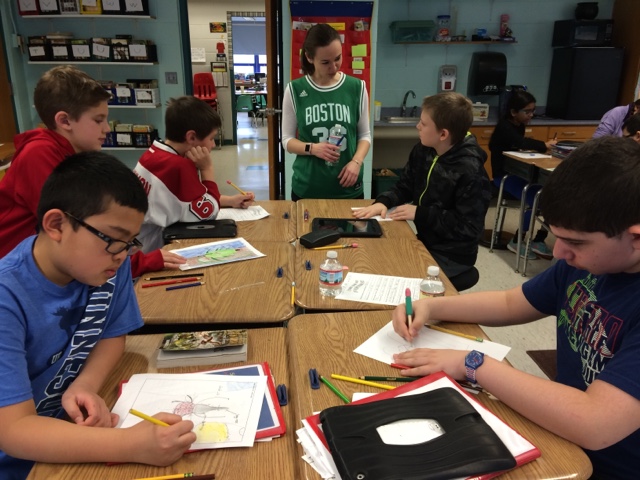 Children were reminded of science from the years past. We are looking at habitats, predator/prey relationships, adaptations, ecosystems and more.
So far, I have seen an elephant beetle with a long pointy nose that stabs to protect itself and colorful venomous invertebrates along with animals with suckers, slime and more. Once the animal drawings are complete, the riddles will be written. These riddles then become the lesson for the different types of invertebrates. Who knew learning could be so engaging!

This 'elephant beetle' will make students start off questioning if it is an insect and then more specifically which one with only a riddle to guide the students on their way. Using the clues, the students will be the scientists to classify these new species!


Although this looks like a fish, don't be fooled; its special structures make it a specific invertebrate. Can you figure out which one? Don't give it away. At this point, students are becoming more independent because they don't want to give away their animal secrets.

This worksheet is just one example of the problem solving that had to be used to work backwards to create a new animal. As the children came to check in, they began to understand the relationship between structures and classification.

Another fun lesson was that of perspective. If an insect is small, how large must a tree or a leaf be? On the other side of this, students will quickly recognize that this animal must be poisonous because of its bright colors. I wonder how this one will catch its dinner. I hope it's an herbivore.


The children have almost completed the information page and drawings. Some are working on the riddle cards...and they are all excited to become THE SCIENTISTS!
Subscribe to:
Posts (Atom)